Research and Experience
Understanding the Research Process
My understanding of the research process developed most concretely when I applied for the Undergraduate Research Experience Award Program (UREAP) grant. Prior to this experience, research felt like an intimidating and overwhelming endeavour, a vast and seemingly endless body of work with no clear starting point. It was through the process of preparing and submitting this grant application that I began to truly understand what research is, what it demands, and why it matters. My supervising professor played an instrumental role during this time, guiding me through what the research process would look like, what was expected, and how to approach it in a structured and meaningful way. That guidance transformed my perception of research from something daunting into something purposeful and achievable.
At its core, the research process is a systematic and disciplined approach to generating new knowledge or deepening our understanding of existing phenomena. It typically begins with identifying a research problem or gap in the literature, followed by formulating a clear research question or hypothesis. From there, a researcher designs a methodology, which is the plan for how data or evidence will be gathered and analyzed. This is followed by the collection and analysis of data, interpretation of findings, and finally, the communication of results through academic writing, presentations, or publications. Each stage builds upon the last, and the process is rarely linear. It requires continuous reflection, refinement, and intellectual honesty throughout.
Understanding this process not only prepared me to conduct my own research effectively, but also gave me a deeper appreciation for the rigor and integrity that scholarly inquiry demands. It laid the groundwork for everything that followed in my research journey.
COMP 3450 Human Computer Interaction and Design
This course introduced us to user-centered research and iterative design. We learned to develop software based on user needs and behaviors, recognizing that effective research requires continuous testing and refinement. We applied these principles by developing Schedulo, a shift-scheduling application featuring real-time updates and an inclusive user interface as a team. This project required us to prototype, test, and revise our assumptions, ensuring the system addressed both technical functionality and ethical design concerns, including cultural bias.
Link to Report: https://github.com/Sugaryeuphoria/Schedulo/blob/main/README.md
COMP 4980 ST: Machine Learning
COMP 4980 provided a technical foundation for the systematic data-driven inquiry central to the research process. I gained expertise in data preprocessing, supervised learning, and model evaluation metrics like precision and recall. For my final project, Predicting Workout Calories Burned, my teammate and I analyzed a dataset of 20,000 records to evaluate multiple regression models. By implementing Gradient Boosting and achieving an R2 of 0.997, I demonstrated my ability to apply rigorous optimization and sequential error correction to reach a validated conclusion.
Link to the Report: https://github.com/Sugaryeuphoria/Predicting-Workout-Calories-Burned-Using-Machine-Learning/blob/main/ML_Final_Project_Submission.pdf
COMP 4980 ST: Behavioral Biometrics
In this specialized course, I learned to design and evaluate continuous authentication systems based on human interaction patterns such as keystroke dynamics and mouse movements. This experience taught me the rigorous research process of extracting features from raw behavioral signals and applying machine learning for identity verification. I also explored the critical ethical dimensions of research, specifically focusing on user privacy, data protection, and the potential for bias in biometric AI systems.
Research Paper: Simulating Human Keystroke Dynamics
For my research paper titled “Simulating Human Keystroke Dynamics,” I investigated whether LLM generated text could mimic human typing patterns using a dataset of 559,000 keystrokes. I employed a sophisticated methodology by fitting statistical distributions to bigram level data and training ensemble classifiers, including Random Forest and Gradient Boosting, to detect synthetic typing. Through clustering analysis, I identified four distinct typing archetypes and discovered that while statistical sampling can approximate human rhythm, machine learning models still detect the absence of key overlap. This project allowed me to manage a complex research lifecycle, from data cleaning and statistical modeling to the creation of an interactive web interface for real time demonstration.
Link to Report: Will add soon.
Evaluating Existing Research
UREAP
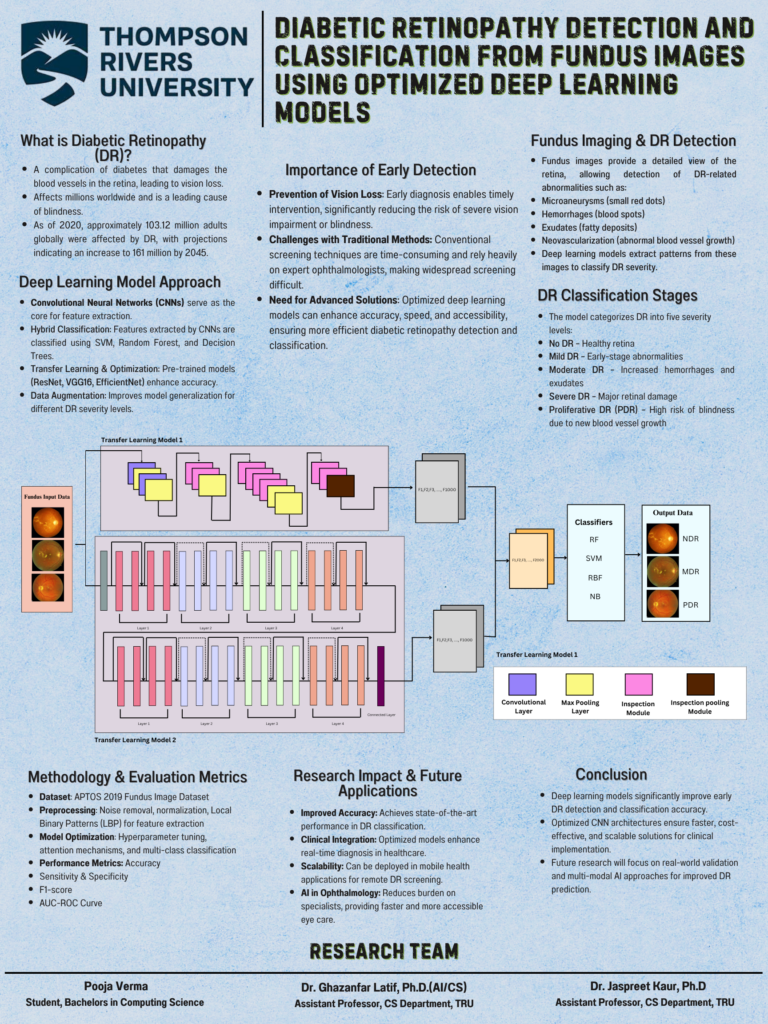
My work in Evaluating Existing Research focuses on identifying gaps in current literature and data to build evidence-based solutions. During my project, I conducted a systematic appraisal of deep learning for diabetic retinopathy detection. By benchmarking existing CNN architectures and performing rigorous literature reviews, I identified limitations in diagnostic accuracy and reproducibility. This evaluative process allowed me to move beyond established models and develop a hybrid deep learning approach that addressed specific deficiencies found in prior studies.
Presentation Deck(From Conference): https://canva.link/n81hevluveff4fl
Literature Review(Also available at Google Scholar): https://doi.org/10.65718/inspireHealth.2026.2005
TRU THINK
In the development of the TRU Think project, we evaluated the landscape of Large Language Models (LLMs) and their limitations in education. We identified a critical gap: most AI tools provided direct answers rather than pedagogical guidance. By evaluating how existing systems retrieved data from platforms like Moodle, we designed a RAG-based system that prioritizes guided hints over direct solutions. This transition to “context-aware support” was the direct result of our collective analysis of the shortcomings of standard generative AI in a classroom environment.
Junior Research Intern
As a Junior Research Intern @Patabid, I am evaluating technical systems and software architecture for a Mitacs project. By assessing existing SDKs and SVG-based editors, I identified efficient integration paths for a new PDF rendering engine that is my project to build. My workflow analysis and technical documentation ensure system scalability, reinforcing that impactful research depends on the critical evaluation of existing technologies and then developing the engine
Research Coach
As a Research Coach, I mentored students in performing critical literature reviews, moving beyond simple summaries toward a synthesis of evidence. By guiding them through topic refinement and methodology appraisal, I reinforced the importance of identifying research gaps. Evaluating academic posters and project components further sharpened my ability to discern the reliability of sources and the structural integrity of diverse research designs.
Presentation Deck: https://moodle.tru.ca/pluginfile.php/4445384/mod_resource/content/0/Research%20Poster%20Ppts.pdf
Applying Research Methods
Deep Learning Approaches
Apply transfer learning and domain-specific preprocessing with Convolutional Neural Networks.
Link to Methodology: (Also available at Google Scholar): https://doi.org/10.65718/inspireHealth.2026.2005
Retrieval-Augmented Generation
Integrate semantic search and transformer-based retrieval models to improve response relevance.
Algorithmic Benchmarking
Conduct extensive benchmarking experiments to evaluate machine learning for disease detection.
Link to poster: https://canva.link/ncklv80xphgupn1
Pedagogical Strategies
Implement guided hint generation instead of direct answers to promote student learning.
System Architecture
Develop components of a rendering engine, installing SDKs and configuring platform licenses.
Technical Documentation
Author detailed documentation to ensure transparency, reproducibility, and structured experimentation workflows.
Analyzing and Drawing Conclusions
The ability to synthesize complex data into actionable insights is the cornerstone of my research methodology. In my study on diabetic retinopathy detection, we analyzed the performance of various hybrid deep learning architectures. By evaluating metrics such as accuracy, sensitivity, and specificity, I concluded that a hybrid approach, combining domain-specific preprocessing with optimized CNNs, significantly outperforms standard models in identifying early-stage retinal pathologies. This analysis addressed the primary research question: “To what extent can hybrid deep learning improve the diagnostic reliability of automated screenings compared to standalone architectures?” The results provided a clear roadmap for more accurate and automated medical diagnostics.

Results: (Also available at Google Scholar): https://doi.org/10.65718/inspireHealth.2026.2005
In the TRU Think project, we drew conclusions from user interaction data and system performance metrics. Our analysis revealed that a retrieval-augmented generation (RAG) based system significantly reduces the hallucination rate of large language models by grounding responses in verified course data from Moodle. We concluded that the system is fully functional and highly effective. This successfully answered our research question: “How can generative AI be adapted to provide pedagogical support rather than direct answers in a university setting?” The conclusion was clear. Context-aware retrieval, paired with guided hinting, fosters a more effective learning environment than traditional AI chatbots.
Knowledge mobilization
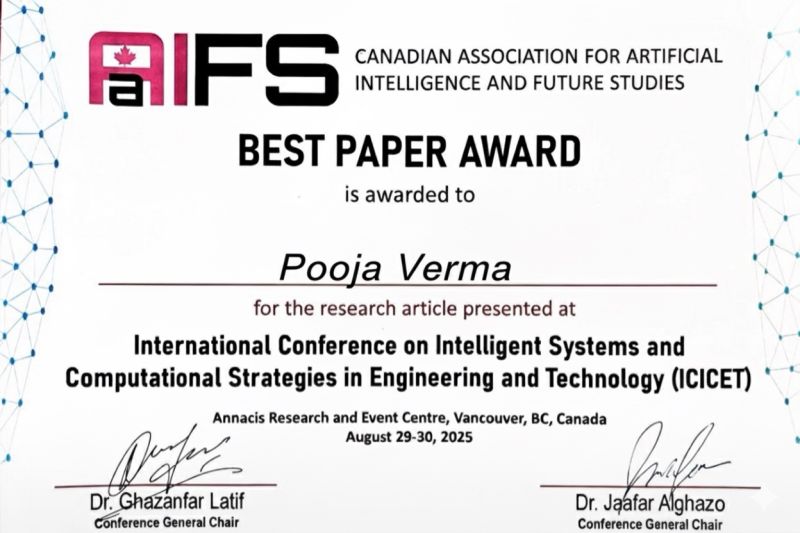
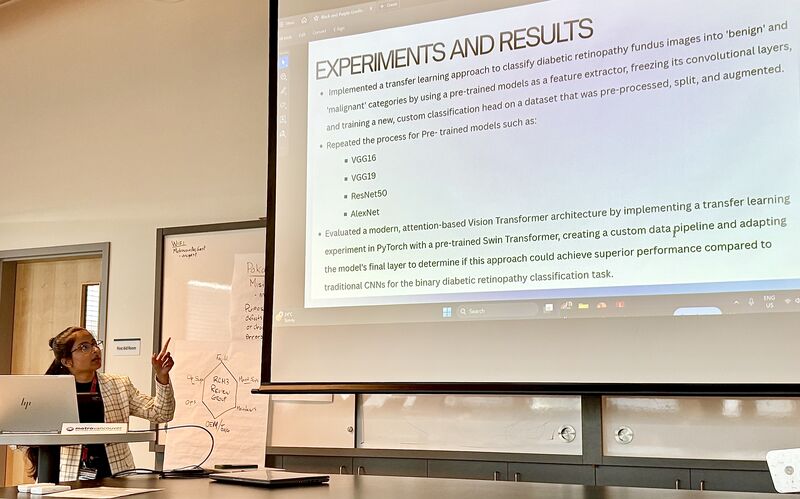
I demonstrate my commitment to knowledge mobilization through the dissemination of my research on automated diabetic retinopathy. At the ICICET 2025, I received the Best Paper Award, which validated the technical rigor of my hybrid deep learning approach and allowed me to engage with global experts on the future of AI-driven diagnostics. This international recognition highlights my ability to communicate complex technical findings to a specialized academic audience.
Link to research paper (Also available at Google Scholar: https://doi.org/10.65718/inspireHealth.2026.2005
Beyond conferences, I successfully navigated the peer-review process to publish my research in an academic journal. By documenting my methodologies and findings, I ensured that my work contributes to the broader scientific discourse on medical imaging, providing a transparent and reproducible record for other scholars to build upon. This formal publication serves as a key bridge between my individual research and the global scientific community.
Locally, I presented my findings at the TRU Undergraduate Research Poster Presentation 2025. This experience required translating intricate machine learning concepts into an engaging format for a diverse audience of students and faculty. Whether through award-winning papers or interactive poster sessions, I prioritize clear and impactful communication to ensure my research drives meaningful progress and fosters interdisciplinary collaboration.
@Copyright 2026